The Tripod Theory, Applied to a One-Person Business
Over the past year I published a series of articles in Digital Asset Management News arguing something that was not especially popular: when AI gives you a wrong or useless answer, the model is almost never the problem. What you fed it is.
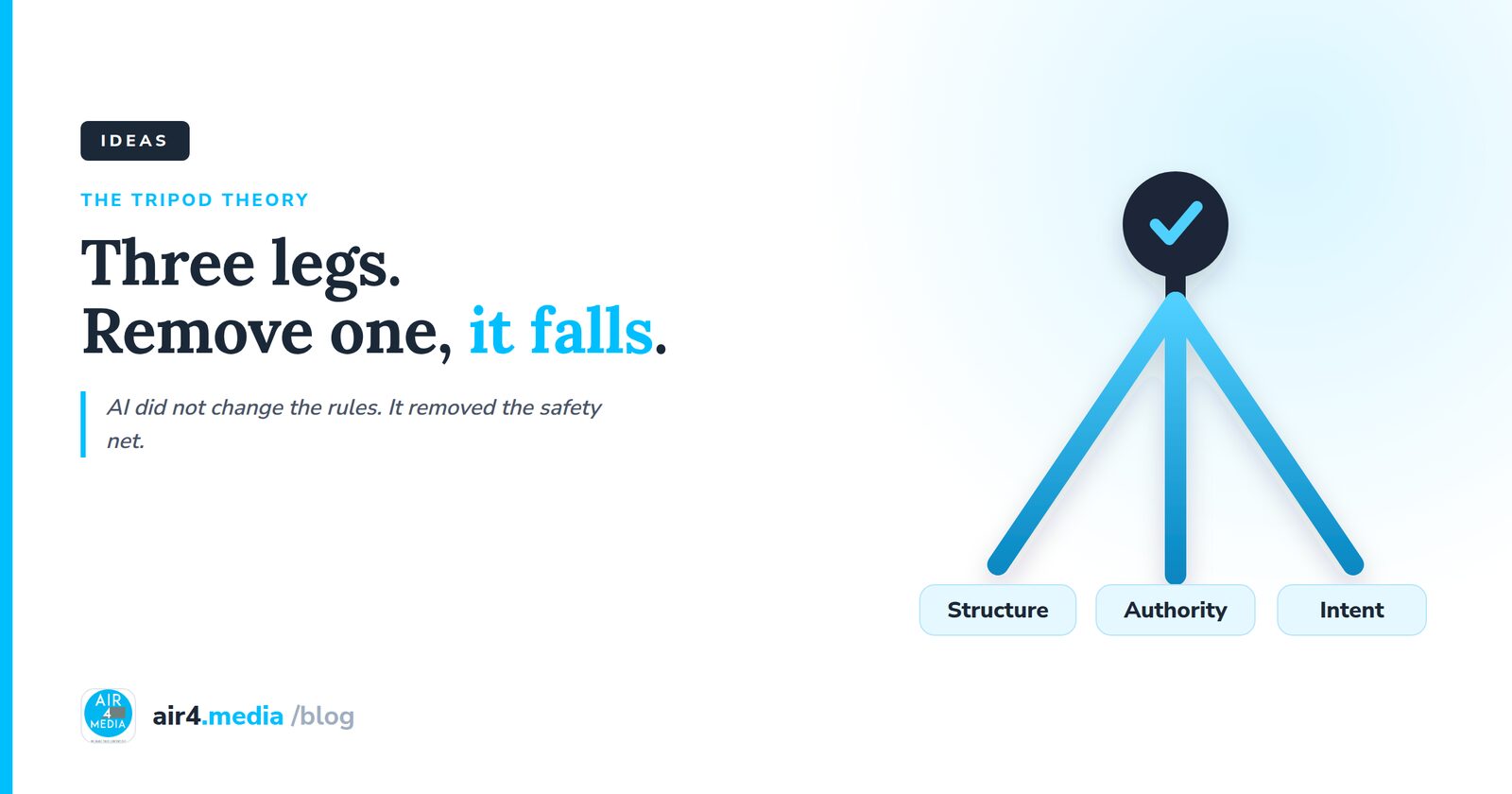
I called the idea underneath them the Tripod Theory. Three forces hold up any system that automation touches: structure, authority, and intent. Remove one leg and the whole thing falls over, no matter how strong the other two look. Or as I put it then: "AI did not change the rules. It removed the safety net."
I wrote that about large organizations with whole teams. It is just as true, and maybe more brutal, when the business is one person.
Structure: one place, not five apps
Structure is knowing what a thing is and where it belongs. In a big company that means taxonomies and states. In a one-person shop it is simpler and harder: is there one place where the client, the photos, the invoice, and the calendar actually live? If the answer is five apps, you are the structure. You are holding it together in your head, and you cannot hand your head to a computer.
Authority: one version that is right
Authority is the ability to say this version is correct and that one is not. When the same client exists in your email tool, your invoicing app, and a spreadsheet, none of them is authoritative. They just disagree politely. Ask an assistant anything about that client and it has to guess which copy you meant, and a guess dressed up in a confident sentence is exactly what people call a hallucination.
Intent: purpose that survives past step one
Intent is the reason the work exists, and it has to survive more than the first handoff. Someone calls. That should become a lead, then a booking, then an invoice, then a line in your books, without you carrying the thread by hand. Most tools drop it immediately. The call ends and the intent dies with it, so you retype the person into the next app and hope you remember why.
Why the AI in most small business tools disappoints
Because it was added on top of five disconnected apps. There is no structure, so it does not know where anything lives. There is no authority, so it cannot tell which copy of your client is real. Intent dies at the first handoff, so it cannot follow the work anywhere. The AI is not the weak part. The floor under it is.
Why Pilot is built the way it is
Pilot is not a CRM with AI bolted to the side. It is the tripod, built for someone running a business alone. One place where everything lives, which is structure. One client that every part of the system reads and writes, which is authority. And work that carries its purpose from the first phone call through the booking and the invoice into your books, which is intent surviving past step one.
That is why the assistant inside it can actually do something useful, and why the same idea in a pile of separate apps keeps producing confident nonsense. Nothing about the model is different. The foundation is.
The full series is collected on our writing page, including the original Tripod Theory piece.
No comments yet. Be the first to share your thoughts!